Chapter 8 of 12 · 2 min read
Observer Attention and Personal Response
Why a stable content score and an observer's self-report must remain different objects.
Inside ~Cortisol Checker~ · v1.0 · Moses Sam Paul
The checker began with my response to language, but its first defensible output could only describe the language. Observer Attention Is All You Need supplied the missing distinction: an observation is situated. Someone observes, at a particular time, from a prior state and a particular context.
That insight could have led to hidden personalization: alter the content score using an identity profile and claim a more individual prediction. The current system takes the opposite path.
The same text receives the same 0.4.1 content score for everyone. No identity value enters the checker. A verified ~WellbeingIdentity holder may separately choose My Response, enter an impact score from 0–100, and select canonical identity facets that they believe were affected. Those values are participant-authored. They are not predictions, prefills, or deductions from private identity data.
This produces two adjacent but non-interchangeable records:
| Object | Source | Meaning |
|---|---|---|
| Content score | Versioned checker rules | Stress-associated patterns found in the submitted text |
| Personal impact | Participant self-report | How strongly this participant says the text affected them |
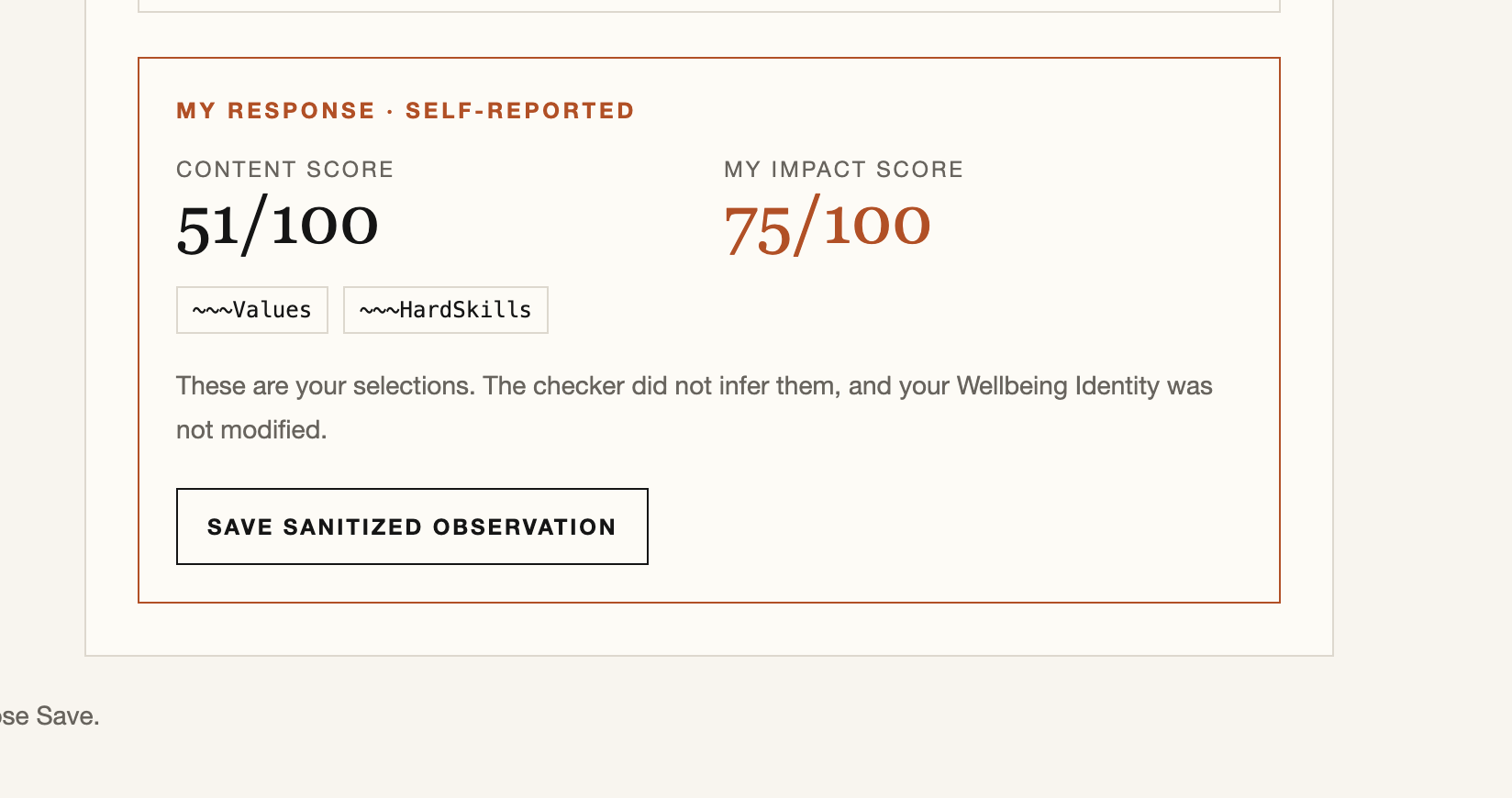
Identity establishes who is responding and the consent boundary around retention. It does not make the classifier clairvoyant. Saving is optional and sanitized; public anonymous analysis remains transient. This is the operational form of represented observation: preserve the difference between what the instrument can calculate and what only the person can report.